Guide To Sourcing & Enrichment
Dealmaking runs on knowing what's happening in the market before everyone else does - sourcing, signals, investor data, and contact details all get lumped together as one problem, and they're not. Here's how to tell them apart, and choose accordingly.

By
Will Sawney
An introductory guide for investment, advisory and brokerage firms using Attio
Dealmaking runs on knowing what's happening in the market before everyone else does. That means direct relationships and access, but it also means sourcing deals, spotting signals, researching companies properly, profiling investors, and finding the right partners. The tools built for this job are often too complex to set up, too expensive to justify, or too basic to actually help. What you want is simple: identify the right target, know about it fast, and be able to reach out before someone else does.
The full process: four functions you might need
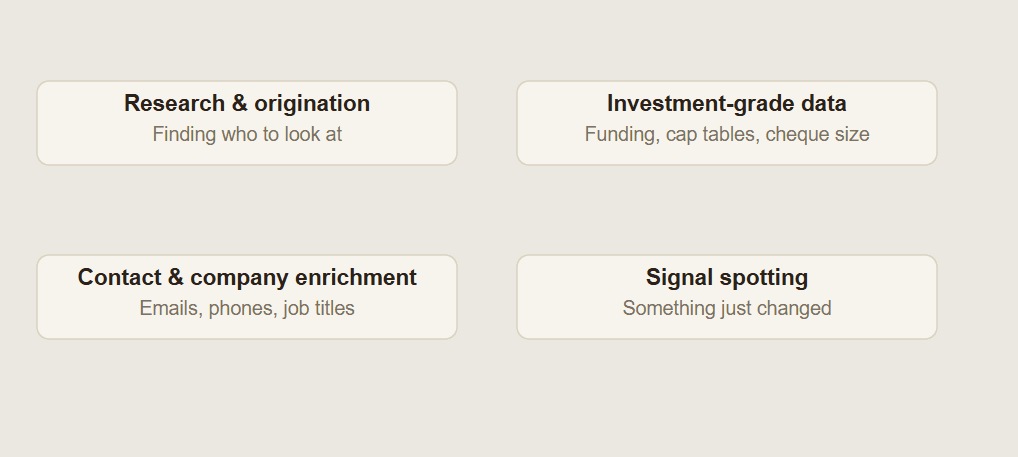
Research & origination - finding who to look at in the first place, including targets that haven't started a company yet. The hardest tier: mostly bespoke digging rather than a database you can filter. Specter and Exa aren't interchangeable here - Specter is a purpose-built database of founder and investor profiles, Exa is a general search layer you point at anything. The former is faster when it already has your target; the latter is what you reach for when nothing else does.
Investment-grade data - fund closes, cheque size, cap tables, funding history. The detail that makes a target genuinely investable rather than just findable. Mostly still lives in the direct sources rather than any enrichment tool - and those sources aren't interchangeable either. PitchBook is deeper and more reliable on institutional and PE data; Crunchbase has broader coverage but shallower detail, better for a first pass than a final answer.
Contact & company enrichment - the commoditised gap-fill: emails, phone numbers, headcount, job titles. Cheap, well-served, and the one job where a flexible platform genuinely earns its subscription. Databar and Clay both cover this well - the real difference between them is per-record pricing versus a flat monthly subscription, not coverage. Worth knowing before you commit: match rates on generic B2B contacts run 60-85% depending on the tool, but on family office and fund-side contacts specifically, expect the low end or worse - it's a corner of the market the big providers don't prioritise.
Signal spotting - the "something just changed" layer: a funding round, a job change, a hiring spike. Thinner than it should be, and the specialist tools here mostly watch the same public sources - job boards, LinkedIn activity, press - so coverage differs less between them than you'd expect. The real differentiator is how fast a tool surfaces the change and how well it filters out noise.
Move from the bottom of that list toward the top and the tools get thinner and more expensive to do well. That's not a gap in the market - it's where a fee is actually justified, rather than something a subscription should be doing for you.
Insight: Bain & Company's research on private equity fund performance found that funds where more than half their closed deals came from proprietary sourcing delivered a median IRR of 23%, against 16% for funds that relied mainly on intermediaries. The hardest tier to source well is also the one with the clearest link back to returns.
Why split it into four at all? Because almost every tool in this space was originally built for outbound sales teams running high-volume prospecting, not for dealmakers hunting a small number of the right relationships. That's the bigger market, so the tooling is polished and cheap for volume work - and thins out fast the moment your job looks more like research than prospecting. How well a tool fits you depends entirely on which of the four jobs above you're actually doing.
—
Which tool do you need?
Usually more than one, but fewer than you'd think. A single flexible platform can genuinely cover two or three of the four jobs above - most dealmakers end up running one workbench tool for the bulk of it, plus whichever direct source already holds their investment data. Research & origination is the one job that doesn't overlap well with the others; it tends to need its own approach regardless of what you're running for the rest.
These answers might help you choose:
How much do data and enrichment tools cost?
Anywhere from free (Attio's own AI research and enrichment) to a few hundred pounds a month for a flexible workbench platform, plus whatever you already pay for the direct sources (Crunchbase, PitchBook) if you want investment-grade data. Contact-only tools sit at the cheap end; institutional data sources are usually the most expensive line - and the one you probably already have.
Do I always need an annual, expensive subscription?
No. Several tools worth having charge per record rather than per month, so you only pay for what you actually look up. A firm running the same job every week is usually better off on a flat monthly plan; one doing occasional bulk enrichment usually isn't.
Which tools integrate with Attio?
Most of the flexible workbench platforms sync natively. Some of the point specialists and direct sources don't - you're exporting from the source and importing into Attio by hand.
Could using these tools compromise a confidential process?
Sometimes. Enrichment tools work from public and semi-public sources - LinkedIn, company sites, news, filings - which is fine for general prospecting. But some signal-spotting features, like job-change or hiring-spike alerts, are effectively shared activity feeds: anyone else running the same tool against the same targets sees the same thing at the same time. On a mandate where genuine information edge matters, that's a reason to lean on direct relationships and primary research rather than the automated layer.
Can't Attio do this itself?
For basic firmographic and contact detail, yes - Attio's own AI research does a reasonable job for free. What it isn't is a data source in its own right; it doesn't hold investment-grade fund or cap-table data, and it isn't built to run a bulk enrichment job across hundreds of records.
Sourcing tools are disposable - whichever one wins this year gets swapped for something else within two. Attio's job isn't to source. It's to be the one place that remembers a relationship exists at all, regardless of which tool found it or what stage it's currently at.
—
Need help choosing?
Every dealmaker's workflow is different - what works for a VC portfolio doesn't work for an M&A boutique. If you want a second pair of eyes on how this maps onto your own, get in touch.
Start here: book a call or send a message
35+ successful setups since 2023
Ready when you are.
Book a free 20-minute initial scoping call where we'll explore your situation and ambitions. I'll provide clear recommended next steps.


